
Australians hold more than $4 trillion in superannuation, yet many young Australians are unable to enter the property market. This tension has led the Coalition to consider allowing the use of superannuation as collateral or withdrawing a sum for a house deposit in a bid to lift home ownership.
“We want to have a country where people can live in their own house … if their superannuation can help them do that, then we should look at that.”- Shadow Housing Minister Andrew Bragg
In this article, we unpack what’s been proposed, how it would work, the strongest arguments on both sides, and what it means for borrowers right now.
What is Actually Being Proposed?
The Coalition’s policy at the last two elections was to allow people to withdraw $50,000 from their super to put towards a house deposit. However, this policy was never progressed.
On 22 September, Shadow Housing Minister Andrew Bragg addressed the Financial Services Council to reopen the super-for-housing debate. He canvassed several models including keeping money inside super as loan collateral or an offset, or withdrawing it for a deposit or to pay down a mortgage.
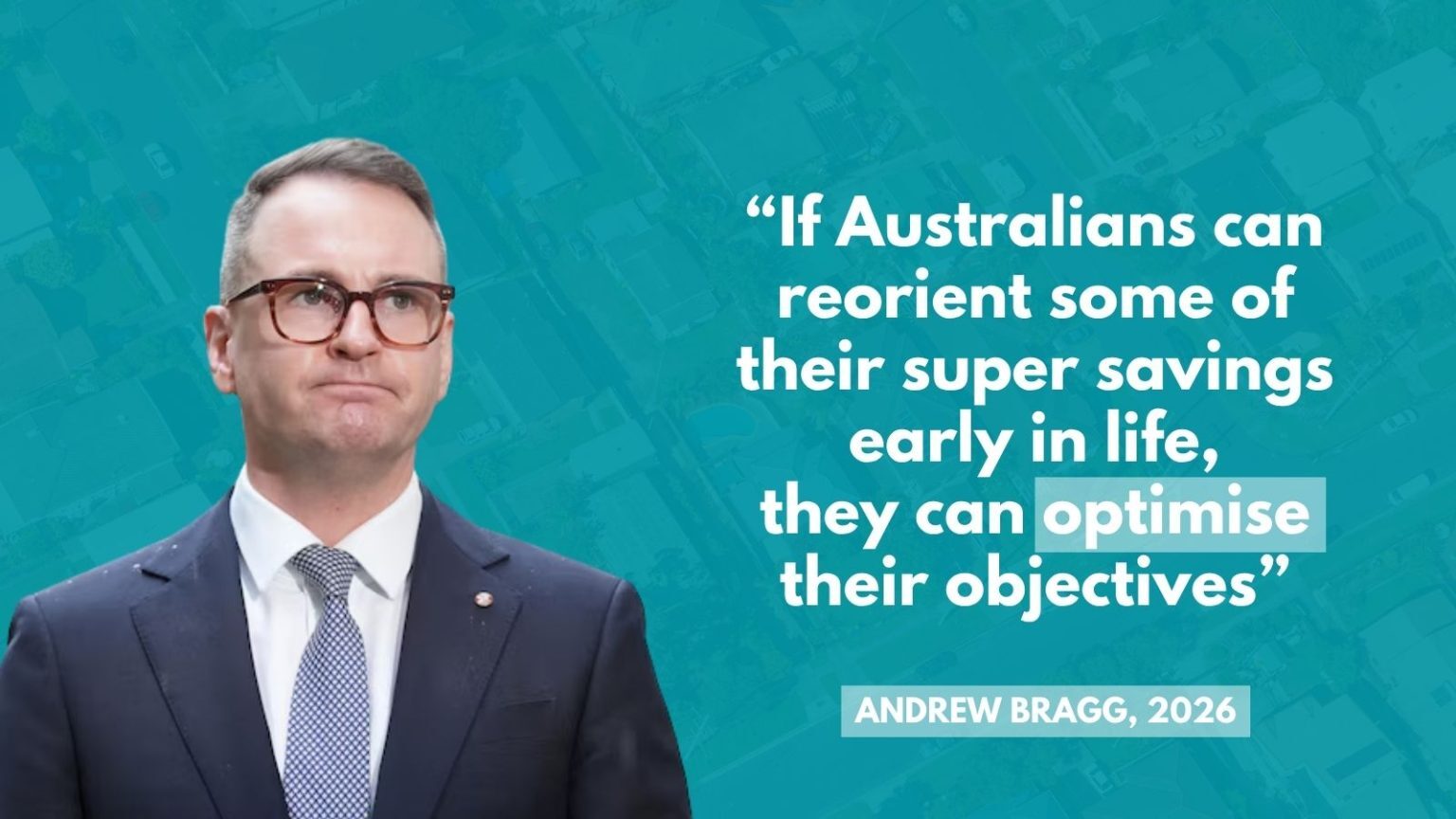
His stated aim is to stop Australia becoming a nation of retired renters. “If Australians can reorient some of their super savings early in life, they can optimise their objectives’’ Mr Bragg said.
In contrast, Opposition Leader Angus Taylor said that the proposed idea is “No longer the Coalition’s policy position”.
“Superannuation is Australians’ money… They should have a choice in it. That’s why we strongly support self-managed super funds”- Angus Taylor (Opposition Leader).
In response, Treasurer Jim Chalmers opposed Bragg’s proposition, highlighting that “Super is for retirement… it’s important to the future of our country, the economy, retirement incomes, and budget pressures.” Chalmers further accused the Coalition of attempting to “vandalise” the superannuation system.
Meanwhile, a DemosAU poll of 1,583 voters found 60% support for using super as collateral, including 55% of Labor voters. One Nation has separately proposed letting workers keep 3% of salary out of super for three years to cover rent or a mortgage.
Super as Collateral vs Withdrawing Super: What’s the Difference?
Under the proposed policy, the coalition has proposed using super as collateral to get a bigger loan, using it as an offset on your mortgage to reduce interest or cashing it out to enter the housing market.
Under a collateral model, your super stays invested and keeps compounding. The lender simply gets a claim over part of it, which counts towards your security the way a family guarantee or a larger deposit would.
In practice, that could mean borrowing at a lower loan-to-value ratio, avoiding lenders’ mortgage insurance, or qualifying sooner. The money is only touched if you default and the sale of the property does not cover the debt.
That is the key difference from the Coalition’s old $50,000 withdrawal pledge. A withdrawal permanently removes money from your retirement balance and hands it to the vendor. Collateral leaves it working for you unless things go badly wrong.
For context, first home buyers can already use the 5% First Home Super Saver Scheme, allowing young Australians to make voluntary contributions of up to $15,000 a year and later withdraw up to $50,000 of those contributions for their first home. Compulsory contributions are off limits.
The Benefits of Using Your Super as Mortgage Collateral
- Homeownership is part of retirement security.
Australia’s retirement system is built on an unstated assumption that retirees own their home outright. The family home is excluded from the age pension assets test, and the pension rate is set with low housing costs in mind. A retiree who rents can spend a large share of their income on housing, and the 2020 Retirement Income Review found renters were among the retirees most exposed to financial stress. - The money keeps compounding.
The central weakness of withdrawal schemes is lost compounding. Take $50,000 out at 30, and you lose not just $50,000 but decades of investment growth on it. Collateral avoids this, because the balance stays invested in the member’s chosen option throughout the life of the loan.
The risk to the balance is also narrower than it first appears. Under most proposed models, the lender would sell the property first and could only call on pledged super to cover any shortfall. Taylor and Tulip point to Australian court data showing mortgage repossessions have historically been rare. For most borrowers, the pledge would be released untouched as their loan-to-value ratio falls. - It closes the deposit gap that keeps buyers waiting.
For many first-home buyers, the barrier isn’t repayments but the deposit. Saving 20% can take years while prices keep rising. Buyers who borrow with a smaller deposit usually pay lenders mortgage insurance, a one-off cost that protects the bank, not the borrower. Pledged super could do the same job as a larger deposit, cutting or removing the need for LMI and letting buyers move sooner. It works much like a family guarantee, where parents put up equity in their own home as extra security. A super-backed version would extend that advantage to buyers whose parents can’t provide it. - Borrowers have skin in the game.
Tulip’s qualified support rests on incentives. When buyers put their own retirement savings on the line, they should be more careful about how much they borrow and how hard they bid. This contrasts with the government’s 5% deposit scheme, where a government guarantee replaces LMI and taxpayers carry much of the risk if a loan goes bad - It is the buyer’s own money.
Bragg frames it as a fairness question. He asks why large institutions can own housing under government policy while individuals can’t use their own savings to secure a home. Whatever you think of the policy, that point is resonating especially with the results of the DemosAU poll that found majority support across party lines.
The Risks of Using Your Super as Mortgage Collateral
- More borrowing power means higher prices.
Any policy that lets buyers borrow more, without more homes being built, tends to flow into prices. Taylor and Tulip’s own paper concludes super-for-housing lifts ownership but worsens affordability when supply stays restricted. The Super Members Council says the idea misses what is really keeping buyers out. - Defaults hit hardest when things go wrong together.
Foreclosures are rare in good times. But job losses, rate rises and falling prices tend to arrive together, which is exactly when pledged super would be called on. A borrower could lose their home and a chunk of retirement savings in the same downturn. - It helps those who need it least.
Younger and lower-income buyers often have small balances, so the extra borrowing power flows mainly to older, higher-earning buyers. Critics also warn that weaker balances in retirement could shift costs onto the age pension. - Super is compulsory for a reason.
Treasurer Chalmers’s position is that super exists to fund retirement. Opening it to housing, however cleverly, sets a precedent for other pre-retirement uses.

The Details that Decide It
Bragg did not say who would be eligible or how the policy would interact with the 5% Deposit Scheme. Those gaps matter more than the headline. Before anyone can judge the idea, it needs answers on:
- How much of a balance can be pledged, and is there a floor that must always stay protected for retirement?
- Eligibility of first home buyers only, as earlier Senate enquiries suggested, or anyone paying down a mortgage?
- Must the lender sell the property first and only then call on super, and only for the shortfall?
- Will banks and the Australian Prudential Regulation Authority (APRA) actually recognise pledged super as security, and will it reduce Lenders Mortgage Insurance (LMI) in practice?
- How do trustees hold a lien over a member balance, including through market swings, fund switches and death benefits?
- Is it paired with measures that increase housing supply, so the extra borrowing buys homes rather than higher prices?
Our View and What It Means For You
If super is going to play any role in housing, collateral is the least damaging way to do it. It keeps balances invested, puts any risks on the borrower rather than the taxpayer, and avoids the one-way transfer of a straight withdrawal.
However, it is not a fix for affordability. Super as collateral only addresses the deposit issue, not the repayment issue. It does nothing to reduce the price of a home, the size of the loan or the repayments that come out of a buyer’s income each month. A household that can’t comfortably service a mortgage today won’t be able to after pledging its super either.
The deposit benefit also tends to erode once it’s widely available. In a market where supply is slow to respond, homes go to whoever can bid the most. If every first home buyer gets the same boost to their borrowing capacity, they compete against each other, and much of the advantage ends up in the sale price rather than in buyers’ pockets. Australia has seen this pattern with first home buyer grants and stamp duty concessions, where demand-side support has often been absorbed into higher prices.
Collateral could still be a useful tool. Designed well, with clear parameters around borrowing, a protected retirement floor and property-first recovery, it could help some Australians purchase a property. Designed loosely, it risks higher prices and exposed retirement savings. Either way, it’s a complement to supply reform, not a substitute for it.
Ultimately, this debate is about more than a single policy lever. Whichever side of politics prevails, pressure to make super work harder for younger Australians is unlikely to fade. The real test will be whether any reform improves access to housing without simply inflating prices or eroding the retirement security the system was built to provide.
For brokers, these new political proposals will bring client questions well before any policy is mandated. Now is the time to set expectations, steer clients towards the options available today and keep serviceability at the centre of every conversation.