
The recent collapse of the Bathla Group has sent shockwaves throughout Australia’s property and construction industry, leaving significant uncertainty for property buyers, contractors, suppliers, employees and private lenders.
Within days of restructuring firm ‘Teneo’ being appointed as administrators, the Australian Financial Review confirmed that Bathla staff were stood down; the NSW government knocked back a request for emergency funding and thousands of clients’ homes, plus numerous businesses connected to its projects, face financial uncertainty.
What Happened to Bathla Group?
Bathla was one of the largest residential developers and builders nationally, dominant across Western Sydney and with major projects in other parts of Australia as well. However, in late August, when administrators Teneo were appointed, a “perfect storm” of financial difficulties was showcased, with over $3.2 billion in liabilities, roughly 2,000 homes mid-construction, and thousands of buyers left waiting to find out if their off-the-plan purchase will ever be finished.
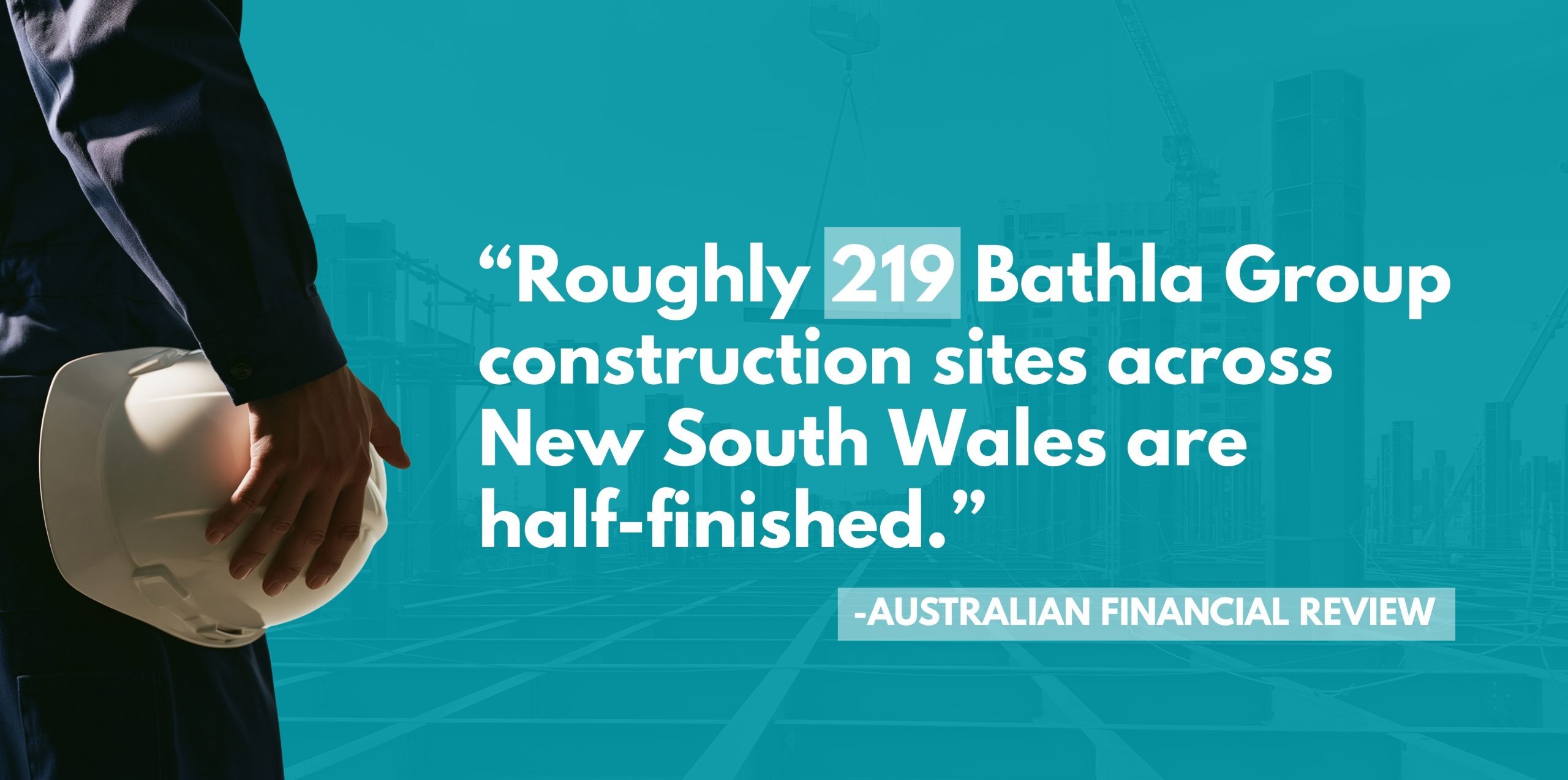
Currently, Teneo is focused on understanding the Bathla group’s financial position and working out whether current construction projects can continue. Teneo has said its priority is to stabilise the business and maintain construction and settlements where possible, while limiting the disruption to employees, customers and contractors.
Voluntary administration does not automatically mean every Bathla project stops permanently, but the administrators still have to work through the assets, liabilities, funding and viability of each part of the business before any of those calls get made. That’s not a guarantee of a good outcome for any individual client, but it’s also a reason not to assume the worst outcome before the facts are in.
Not Every Bathla Client is Exposed the Same Way
Across all Bathla projects, clients are all in different stages of each project; this also reflects and highlights where each client is vulnerable in this situation. Buyers who are still at the deposit stage of an off-the-plan purchase, and haven’t yet drawn down a loan, are generally the least exposed group, even though they’re often the most anxious. Their risk sits with the deposit rather than with a loan facility, so the two things actually worth confirming are whether that deposit is held in a regulated trust account rather than paid straight to the developer, and whether the contract gives them a right to have the deposit refunded, or the contract cancelled, if the builder can’t complete.
A broker’s natural point of engagement with this group tends to come later in the process rather than earlier, so if brokers are engaged, it’s worth checking with the client’s solicitor, rather than the client, to confirm the trust and refund position is sound.
The real exposure generally shows up with construction loans. These are typically drawn down in stages as the build progresses, with the lender releasing each portion of funding as the builder completes that stage and it’s certified. When a builder stops building, the lender generally stops funding the next stage too, because there’s nothing completed to certify and release payment against. We have seen this occur with Bathla, with banks refusing to provide more funding to the development of current projects.
This situation highlights a higher exposure where a client can be left holding a loan against a partially built property, with the next drawdown frozen and no clear date to move again; this is where a broker’s involvement genuinely matters, and where the correct sequential actions are key.
It’s also worth keeping in mind clients whose property was already built and settled before the collapse. Their exposure is generally lower again as the build is finished and the loan has already settled in the normal way. It is still worthwhile for brokers to check in with their clients, as under NSW law, buyers have six years from the date of completion to claim compensation for major defects and two years for other minor defects. This process can become more complicated once the builder itself is no longer trading and unable to fulfil any defect maintenance.
Why Brokers Are Exposed Here, Not Just Clients
Currently, Bathla clients are filled with a lot of uncertainty surrounding the unknown status of the Bathla Group. That’s an uncomfortable position for any broker and a genuinely risky one if you don’t have all the answers. When a builder collapses, the first phone call from a client rarely goes to the administrator, but to the most accessible contact, usually a broker:
- “What does this mean for my loan?”
- “Do I still have to settle?”
- “I’ve paid my deposit… is it gone?”
- “The builder isn’t answering. What should I do?”
Clients experiencing financial stress or confusion tend to direct it to the most accessible person attached to the deal; that’s usually the broker, not the developer and not the administrators. This means the first conversation you have with an affected client matters more than almost anything else. So how do you approach this?
As a broker, when a client tells you their developer has collapsed, there’s a natural instinct to call the client back immediately with answers. Resist from this until you’ve gathered all the necessary information generally, not the other way around. You want to be the broker who says “here’s what I know and here’s what happens next,” not the broker who has to ring back an hour later with updates.
While collecting information, it’s important to be updated on the current status of the client’s purchase and whether the current progress draw has been paid out or is in the lender’s hands, whether the facility is in default or just on hold, and whether the lender has a documented position on builders in administration generally. Lenders that deal in construction finance regularly will often have a bulletin or a dedicated contact for exactly this situation; be sure to ask for it. If your lender doesn’t have a clear answer yet, that’s useful information too! It tells you the honest answer to give your client is “we don’t know yet,” rather than manufacturing false certainty.
It also helps to be able to tell the client, honestly, that their outcome isn’t necessarily the same as every other Bathla buyer’s. The administration process works development by development, so one project may keep moving while another is on hold. A client who understands this is less likely to panic based on a media headline about the group as a whole, and more likely to wait for an official update that’s actually specific to their build.
Also encourage your clients to keep every piece of paperwork, including the contract, any correspondence, and receipts for deposits and payments.
There Are Also A Few Things You Should NOT Say to Your Clients
When your client is stressed and uncertain regarding the status of their build, it’s inevitable that there will be questions that you won’t have the answer to. It’s essential to avoid the following:
- Don’t speculate or promise timelines: You don’t have all the information, and administrators themselves often don’t have a firm answer in the early days. “I don’t know yet, and here’s how we’ll find out” is a complete and reassuring way of ensuring that you will try to find all the information for your client and have their best interest at the forefront .
- Don’t offer opinions on the builder’s, developer’s, or administrator’s conduct: It’s tempting to commiserate by saying what you really think of the people involved. Keep it factual and forward-looking.
- Don’t tell the client what their legal rights are: Refer them to their solicitor. Even an accurate general statement, given without full knowledge of their specific contract, can be read back later as advice you weren’t qualified or engaged to give.
- Don’t go silent: The single biggest driver of complaints in situations like this isn’t bad news… It’s no news. A short update saying “still waiting on the advice from administrators, I will call you Thursday with an update” costs you two minutes and prevents a lot of anxiety-driven escalation.

Five Questions That Would Have Flagged Bathla Group
Developer implosions are rarely a surprise for people who know where to look. A short due-diligence process at the beginning of a deal won’t catch every failure, but it catches more than what most brokers currently check for. Here are the essential questions to implement into your process:
- How is the builder funded, and by who?
Bathla’s collapse followed heavy reliance on private credit. Investigations into reporting procedures following the collapse pointed to private credit funds limiting investor redemptions as pressure built. Traditionally, screening questions revolve around bank versus private lender, whether the borrower actually understands what they’re paying, what security has been given, and whether the business can survive a run of weaker sales on those terms. However, a builder funded predominantly through private credit rather than mainstream bank facilities isn’t automatically a red flag, but it’s a different risk profile; Facilities can tighten or be pulled faster than a bank one, with less public visibility until it happens. Instead, ask how the builder’s own funding is structured, and how concentrated it is with a small number of lenders. - What does the pipeline-to-delivery ratio look like?
A developer with tens of thousands of dwellings in its “pipeline” against a few thousand actually under construction is signalling growth ambition, but it’s also a business that needs continuous sales and continuous credit to keep moving. When sales soften, an organisation built for that pace of growth has less room to absorb the shock than one running a smaller and more conservative book. - How exposed is the builder to a single market segment or region? A builder concentrated heavily in one price point or one region carries concentrated risk. A downturn in that specific segment hits the whole business at once, rather than being absorbed across a diversified project book.
- What’s the builder’s public commentary in the last six to twelve months? Founders and executives talking publicly about “challenging conditions,” cost pressure, or policy changes affecting the business are often signalling something the financials will confirm later. It’s not proof of anything on its own, but combined with the other checks, it’s a data point worth noting rather than dismissing as ordinary industry noise.
- Is the builder’s home warranty insurance current and specific to this project? This is the one that actually protects your client if the worst happens, so confirm it directly rather than assuming it exists because the contract references it.
The Bottom Line
A developer collapse isn’t a broker failure. But how the next few weeks are handled will showcase a lot about the brokers chosen by the impacted clients. A disciplined line on what you will and won’t opine on, and a consistent process of documentation will get most brokers through similar situations cleanly.